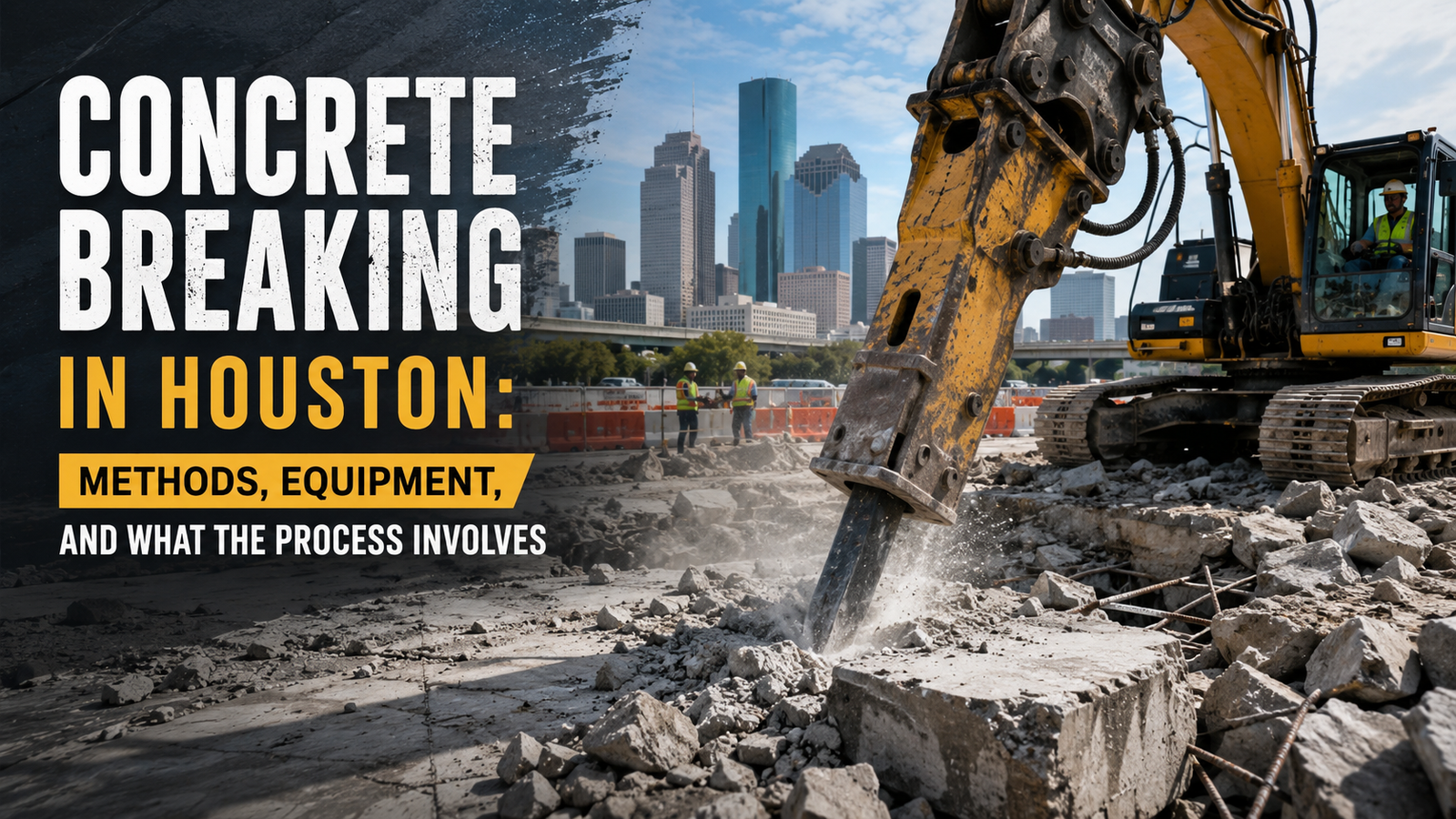
Concrete breaking is the first essential step in any concrete removal project the controlled fracturing of hardened concrete surfaces, slabs, walls, or structural elements into pieces that can be loaded, hauled away, and recycled. In Houston, concrete breaking is in constant demand across residential, commercial, and industrial projects of all scales. From residential driveways and pool demolitions to industrial facility floor removal and infrastructure deconstruction, professional Concrete Breaking Houston turns what might appear to be an immovable mass into manageable material ready for the next phase of the project. This guide explains what concrete breaking involves in the Houston context, the methods and equipment used, and what property owners and project managers should understand before this phase of work begins.
Why Concrete Breaking Is Its Own Specialized Service
Concrete is among the most durable construction materials humans have produced. Its compressive strength the resistance to being crushed is the property most commonly specified in construction, and modern concrete mixes used in Houston construction routinely achieve 3,000 to 5,000 pounds per square inch (PSI) of compressive strength. Some specialty concrete used in industrial applications in Houston’s petrochemical corridor reaches significantly higher strengths. Breaking concrete efficiently and safely requires equipment specifically designed to overcome these material properties.
The challenge increases when steel reinforcement is present which it is in virtually all structural concrete and most flatwork. Rebar, welded wire mesh, and post-tensioning cables embedded in concrete add tensile strength that prevents the concrete from simply crumbling when struck. Reinforced concrete breaks into large fragments held together by the steel, requiring both the concrete-fracturing capability of a breaker and the material separation capability to cut or sever the reinforcing steel as pieces are extracted.
Post-tensioned concrete used in some Houston-area parking structures, elevated decks, and certain commercial construction presents additional complexity. Post-tensioned systems contain steel tendons under sustained high tension. When a post-tensioned tendon is cut without being de-tensioned first, the energy stored in the tendon is released suddenly and violently. Identifying post-tensioned concrete before breaking begins and planning the removal sequence to manage this risk is a critical safety consideration that distinguishes experienced Houston concrete demolition contractors.
Equipment Used for Concrete Breaking in Houston
The hydraulic breaker a hydraulic-powered impact tool mounted on the arm of an excavator or other carrier machine is the most widely used concrete breaking tool in Houston. Hydraulic breakers deliver high-energy impact blows at controlled intervals, fracturing concrete efficiently. They are available in a wide range of sizes, from compact attachments for mini-excavators used on residential projects to heavy hydraulic hammers for large-scale commercial and industrial work. The appropriate size is matched to the concrete thickness, strength, reinforcement density, and site access conditions of the specific project.
Mini-excavators equipped with hydraulic breakers are the standard tool for residential concrete breaking in Houston. Houston’s residential lot configurations many with limited side yard clearance and access through a 36-to-48-inch gate make the compact footprint of mini-excavators valuable. These machines can access most residential backyards, position themselves adjacent to pool decks, driveways, and patios, and operate efficiently in confined spaces where larger equipment cannot work.
Full-size excavators (20 tons and above) with hydraulic breaker attachments handle larger commercial and industrial concrete breaking scopes warehouse floor slabs, parking lot removal, tilt-wall panel demolition, and heavy infrastructure concrete. Houston’s commercial construction and industrial demolition market generates consistent demand for large-scale concrete breaking, particularly in the active redevelopment zones along the inner loop and in the industrial corridors serving the Port of Houston and the petrochemical complex.
Pneumatic jackhammers handheld or mounted on equipment handle concrete breaking in interior settings where excavator access is not possible and in detail work adjacent to elements that must be preserved. Interior floor slab removal, pit and trench demolition within buildings, and concrete removal in confined spaces all commonly require pneumatic breaking. Houston’s extensive renovation and tenant improvement market generates steady demand for interior concrete breaking services.
Concrete saws are used in combination with hydraulic breaking when a clean, straight cut edge is required before breaking begins. Sawcutting along the perimeter of the area to be removed creates a clean joint that prevents cracking from propagating into adjacent concrete that is to remain. This combination of sawcutting and hydraulic breaking is standard practice for selective concrete removal in Houston removing a damaged section of driveway or sidewalk while leaving adjacent concrete panels intact.
Common Concrete Breaking Applications in Houston
Pool demolition is one of the most common residential concrete breaking applications in Houston. The region’s hot climate and large suburban lot sizes have resulted in a high per-capita swimming pool ownership rate, and aging gunite and concrete pools that have reached the end of their service life or whose owners want the space for other uses are regularly demolished. Pool demolition involves breaking the pool shell into pieces, removing the broken concrete, and either completely excavating the pool structure (full removal) or breaking the walls inward and filling the void (partial fill). Each approach starts with hydraulic concrete breaking.
Foundation slab removal following house or building demolition is another major application. After the above-grade structure is torn down, the concrete slab-on-grade foundation must be broken and removed before the site can be properly prepared for new construction. Houston’s clay soils make proper subgrade preparation essential for new foundation performance, and this requires complete removal of the existing slab.
Commercial and industrial floor breaking is a significant market segment in Houston’s active commercial real estate environment. When warehouse facilities are repurposed, when manufacturing plants are cleared, or when retail spaces are reconfigured, existing concrete floors may need to be partially or fully removed. Industrial floors in Houston’s manufacturing and petrochemical sectors are often significantly thicker than residential construction 8 to 12 inches or more and may include embedded equipment anchors, pit structures, and trench systems that add scope complexity.
Infrastructure concrete breaking removal of aging bridges, culverts, retaining walls, and pavement is a regular public works activity across Harris County and the City of Houston. The region’s extensive and aging infrastructure creates ongoing demand for professional concrete breaking services in the public works sector.
Debris Management After Concrete Breaking in Houston
Broken concrete from Houston projects is a recyclable material. Crushed concrete aggregate (RCA) concrete that has been broken, loaded, transported to a processing facility, and crushed to aggregate sizes is widely used as base material for roads, parking lots, driveways, and commercial development throughout the Houston area. The active construction market in Harris County and surrounding counties creates sustained demand for recycled concrete aggregate, making concrete recycling both economically rational and environmentally beneficial.
Steel reinforcement recovered during concrete breaking is separately sorted and sold to scrap metal facilities. In large-scale commercial and industrial breaking projects, the scrap value of steel reinforcement can be meaningful. Concrete breaking contractors in Houston who actively separate and recycle these material streams provide better overall project economics than those who simply haul everything to landfill.
Frequently Asked Questions About Concrete Breaking in Houston
What is the difference between concrete breaking and concrete cutting? Concrete breaking uses impact energy (hydraulic breakers, jackhammers) to fracture concrete into irregular pieces for removal. Concrete cutting uses rotating diamond saw blades or diamond wire to create precise, clean cuts through concrete without fracturing the surrounding material. Both are commonly used in concrete removal cutting is often used first to define the removal boundary, and breaking is then used to remove the concrete within that boundary.
Can concrete breaking damage adjacent structures or utilities? Hydraulic impact breaking creates vibration that can transmit through the ground and through connected concrete structures. In sensitive environments near foundations, near buried utilities, or in structures where adjacent elements must be protected sawcutting to isolate the removal area and using smaller breakers reduces transmitted vibration. An experienced contractor assesses these risks before work begins and chooses methods and equipment appropriate to the site conditions.
How is reinforced concrete handled differently during breaking? Reinforced concrete breaks into large fragments held together by steel rebar or mesh. Operators must periodically stop the breaking process to cut rebar with bolt cutters, hydraulic shears, or torches to free sections for removal. This adds time to reinforced concrete breaking compared to unreinforced flatwork of the same thickness.