Many towns and cities have thousands of old street lights that still work but cost too much to run. Some use outdated sodium or mercury lamps, some sit on unreliable grid circuits, and some are on roads where cable faults have left whole sections dark. Replacing everything with new poles and new solar systems is one option, but it is not the only one. Retrofitting, converting existing street lights to solar, can be faster and cheaper when the conditions are right.
This article explains what solar retrofitting means, when it makes sense, and what to check before deciding.
What Does Retrofitting to Solar Mean?
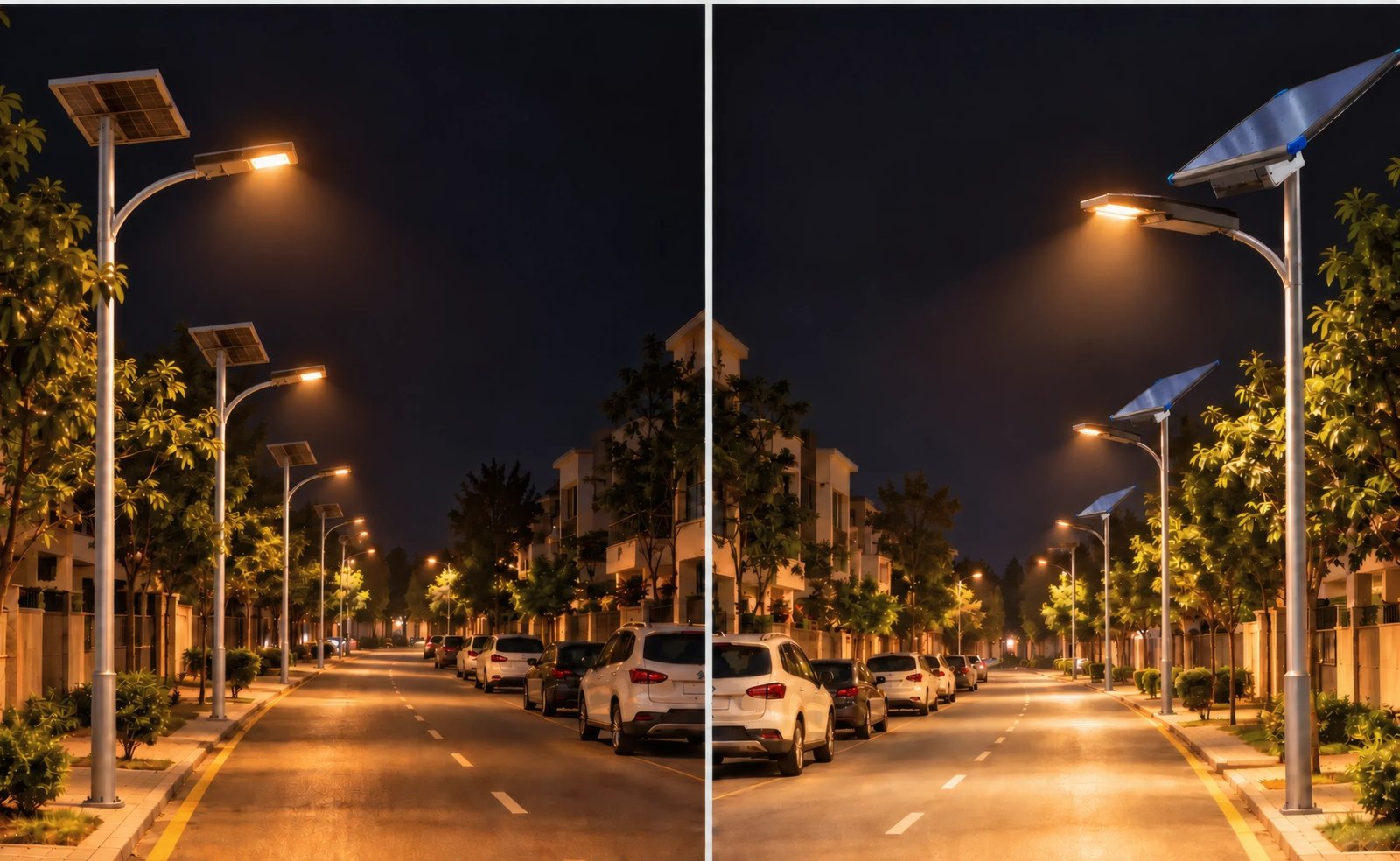
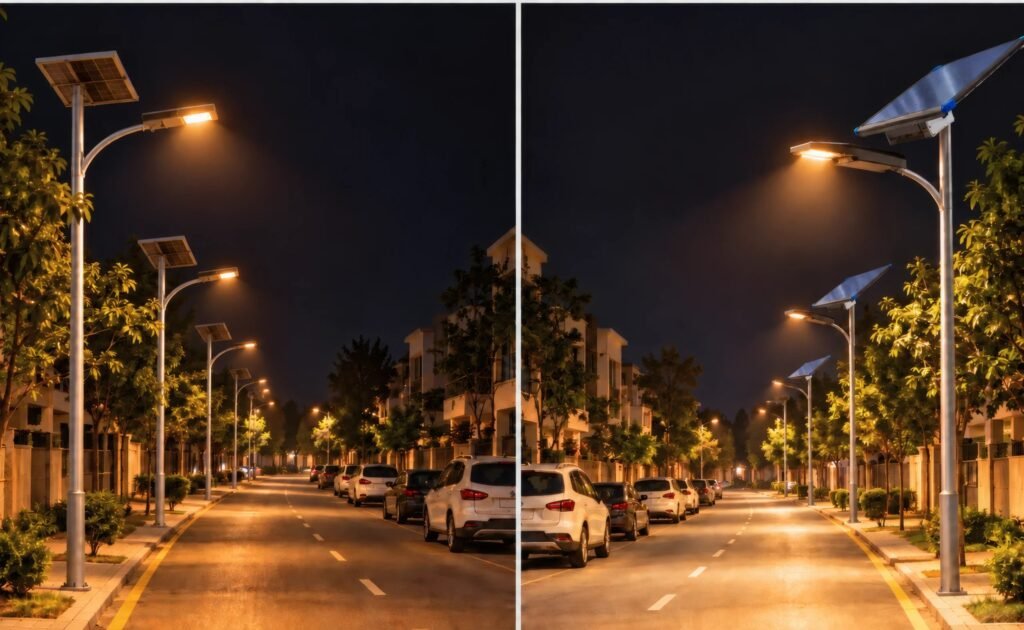
Retrofitting means reusing parts of the existing street lighting, usually the poles and sometimes the arms, while replacing the light source and power supply with a solar system. In a typical retrofit, the old lamp is removed and a solar LED luminaire is mounted on the existing pole or arm, with a solar panel and battery either built into the luminaire or mounted on a bracket on the pole. The light then runs independently of the grid.
When Retrofitting Makes Sense
Retrofitting is a good option in several common situations:
- The poles are in good condition. If the existing poles are structurally sound, reusing them saves the cost of new poles and foundations.
- Electricity is expensive or unreliable. Converting to solar removes the energy bill and keeps roads lit during outages.
- The cable network is failing. Old underground cables that keep breaking can be retired instead of repaired.
- Roads cannot be dug up easily. In busy town centres or historic streets, avoiding new trenches and foundations reduces disruption.
- Budgets are limited. Reusing poles lowers the cost per light, so more streets can be upgraded with the same budget.
When It Does Not Make Sense
Retrofitting is not always the right choice. A new installation may be better when:
- The poles are rusted, damaged or near the end of their life.
- The existing poles are too short or too far apart for the light level the road now needs.
- The poles cannot safely carry the extra weight and wind load of a solar panel.
- Tall buildings or trees shade the existing pole positions for much of the day.
Key Checks Before a Retrofit
Pole condition and strength
Each pole should be inspected for corrosion, cracks and base condition. The pole must also be able to carry the solar panel’s weight and wind load, which may be more than the original lamp. On larger projects, an engineer should confirm this.
Height and spacing
The existing pole height and spacing were designed for the old lamps. A lighting calculation should confirm that the new solar luminaires will light the road evenly from the existing positions. Sometimes a few extra poles are needed to fill gaps.
Sun exposure
Every pole position needs enough sunlight for the panel. Poles in deep shade may need a panel mounted on a longer bracket, a different position or a different solution.
Arm and bracket fit
The new luminaire and panel bracket must fit the existing arm or pole top. Many manufacturers offer adapters and brackets designed for common pole sizes.
System sizing
As with any solar street light, the panel and battery must be sized for the cloudiest month, with enough autonomy for several dark days in a row.
The Benefits of a Well-Planned Retrofit
When the existing infrastructure is sound, a solar retrofit can deliver many of the benefits of a new solar installation at a lower cost. Roads stay lit during grid failures, electricity bills for street lighting disappear, and the old cable network no longer needs repairs. Because the poles are already in place, installation is fast and causes little disruption. Specialist solar street light retrofit solutions are designed to mount on existing poles and arms, which simplifies the conversion.
Planning a Retrofit Project
- Survey every pole: condition, height, spacing, arm type and shading.
- Run a lighting calculation using the existing pole positions.
- Decide which poles can be reused and which need replacing or adding.
- Size the solar system for the local climate.
- Choose luminaires and brackets that fit the existing poles.
- Plan the installation to minimise disruption to traffic and residents.
- Set up a simple maintenance plan for panel cleaning and battery replacement.
Frequently Asked Questions
Is retrofitting cheaper than a new installation?
Usually, because the poles and foundations are reused. The saving depends on how many poles are in good condition and whether extra poles are needed to meet today’s lighting levels.
Can any pole be converted to solar?
No. The pole must be structurally sound, tall enough for the light level needed and strong enough to carry the panel’s weight and wind load. A survey and, on larger projects, an engineering check confirm this.
What happens to the old cables?
Once the lights run on solar, the old cables can be disconnected and left in place or removed during other road works. They no longer need maintenance.
How long does a retrofit take?
With poles already in place, each light can often be converted in a short visit, so even large streets can be upgraded quickly with little disruption to traffic.
Will the converted lights look different?
The luminaire will be new and the pole will carry a panel or a compact solar unit, so the street will look more modern. Choosing slim fixtures and matching colours keeps the change neat, which matters in historic town centres.
Can a retrofit be done in phases?
Yes. Because each solar light is independent, a town can convert the most important streets first and continue street by street as budgets allow.
Final Thoughts
Retrofitting existing street lights to solar is one of the most cost-effective ways for towns and cities to cut energy costs and improve reliability, as long as the poles are sound and the design is checked properly. A careful survey, a lighting calculation and a system sized for the local climate are what separate a successful retrofit from a disappointing one. Working with an experienced solar street light manufacturer helps make sure the new lights fit the old poles and perform for years.